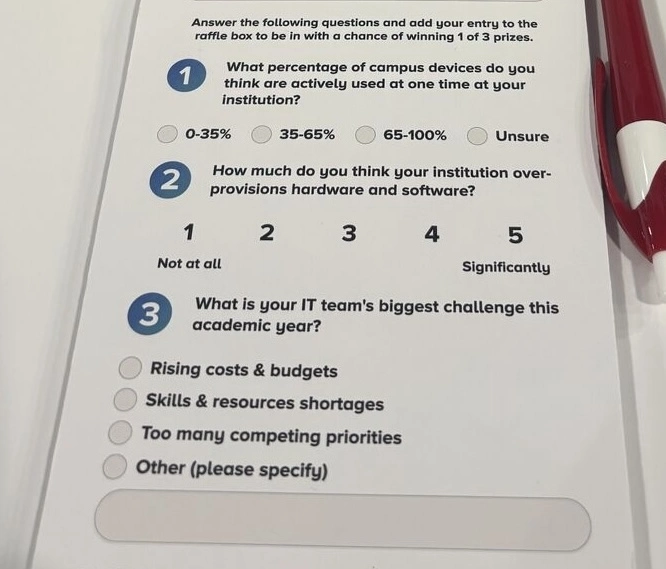
Hardware, software and operating costs keep rising, without a similar increase in funding. That was the biggest challenge reported by the higher education IT leaders we surveyed at this month’s EDUCAUSE Annual Conference.
Overprovisioning is a familiar problem in higher education, so we wanted to understand how aware leaders were of waste within their existing IT infrastructure. How much room did they see for making better use of the devices, software and infrastructure they already fund?
More than half know they overprovision
57% of respondents rated their institution’s overprovisioning at one of the two highest levels on a five-point scale.
This shows most leaders already recognize that their provision exceeds demand. At a time when budgets are stretched, money continues to go toward capacity they know they are not fully using.
The cost extends beyond the initial purchase. Every additional computer, application and environment brings ongoing work to maintain, support and secure it.
Hardware usage remains a blind spot
Only 23% of respondents thought more than 65% of their devices were used simultaneously. The majority, 56%, estimated usage at 65% or below, while 21% were unsure.
Even these estimates look high alongside LabStats data, which shows average simultaneous device usage of around 28%. Individual campuses vary, but the comparison raises questions about how closely perceptions reflect actual demand.
One in five leaders could not estimate usage at all. With hardware becoming more expensive, that lack of visibility makes it harder to know whether the next refresh will meet a real need or carry existing waste into another purchasing cycle.
The reality behind the numbers
These findings echoed what we heard in conversations and sessions throughout EDUCAUSE: institutions are wrestling with rising costs while trying to understand where their existing resources could work harder. This comes on a background of restructure and consolidation, designed to save costs and increase efficiency.
The biggest barrier is a lack of granular data showing where and how students use software and hardware, which labs they prefer and which they avoid. Without that detail, IT teams cannot confidently identify which devices, licenses or spaces can be reduced or repurposed.
Changing provision can feel like a house of cards: removing the wrong piece can create problems elsewhere. Without detailed evidence, proposed changes can also become a source of conflict with faculty and other internal stakeholders who need confidence that teaching and student access will be protected.
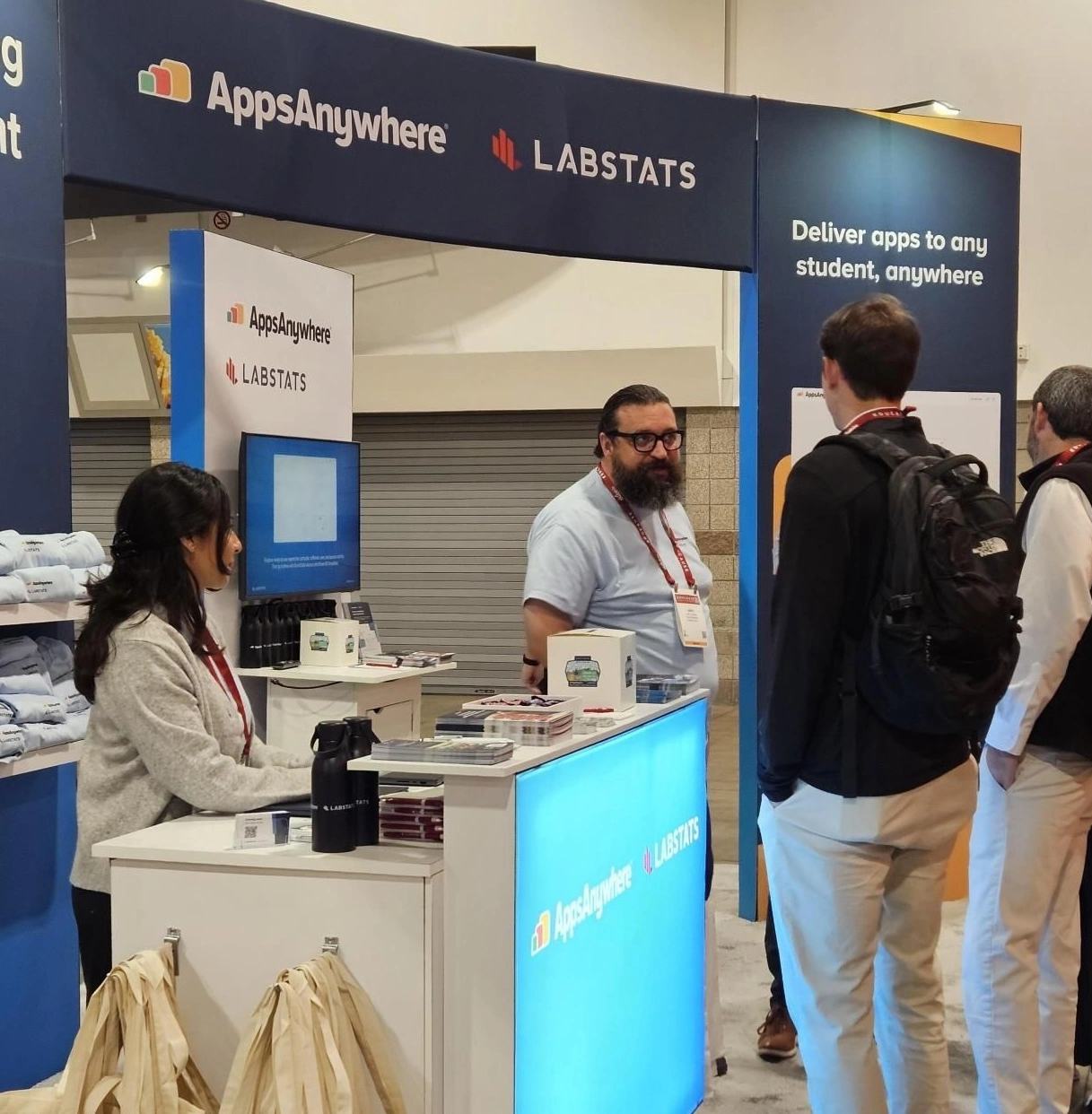
IT leaders sharing their perspectives at Educause 2026
The impact of visibility
We see the financial significance of better visibility in our customers’ results. Once institutions start measuring demand and changing how software is delivered, and how devices can be optimized to real need, saving opportunities emerge across hardware, licenses and space.
York University reduced UIT-managed student lab seats by 70% between 2018 and 2026, with approximately $1.74 million in estimated cumulative savings associated with those reductions. AppsAnywhere enabled broader software access beyond fixed labs, while LabStats provided evidence to support changes to provision.
At BCIT, usage data revealed that expensive, high-spec computers were frequently handling basic tasks. Matching general-use devices to those workloads freed budget for specialist equipment where the processing power was needed.
In most cases, the main goal was to improve student access, while the savings were the by-product. With students prefering to use their own devices and hybrid learning expanding, managing idle computers or paying for licenses based on part-time users becomes a visible waste of resources.
AppsAnywhere is a global education technology solution provider that challenges the notion that application access, delivery, and management must be complex and costly. AppsAnywhere is the only platform to reduce the technical barriers associated with hybrid teaching and learning, BYOD, and complex software applications, and deliver a seamless digital end-user experience for students and staff. Used by over 3 million students across 300+ institutions in 22 countries, AppsAnywhere is uniquely designed for education and continues to innovate in partnership with the education community and the evolving needs and expectations of students and faculty.
Register your interest for a demo and see how AppsAnywhere can help your institution. Receive a free consultation of your existing education software strategy and technologies, an overview of AppsAnywhere's main features and how they benefit students, faculty and IT, and get insight into the AppsAnywhere journey and post launch partnership support.
Register your interest for a demo and see how AppsAnywhere can help your institution. Receive a free consultation of your existing education software strategy and technologies, an overview of AppsAnywhere's main features and how they benefit students, faculty and IT, and get insight into the AppsAnywhere journey and post launch partnership support.
This section is only visible in the Webflow Designer and Editor (NOT on live site). Use it to design the thumbnail as it will appear if pulled into a related reading component. Make sure you update the links on the thumbnail to point to the current page.
Find out what IT leaders think about their IT provisioning, how perceptions compare to reality, and the savings that can result from provisioning to demand